
Virtual Assistant Provider guide
What Should a Virtual Assistant Do When the Source Record Is Wrong?
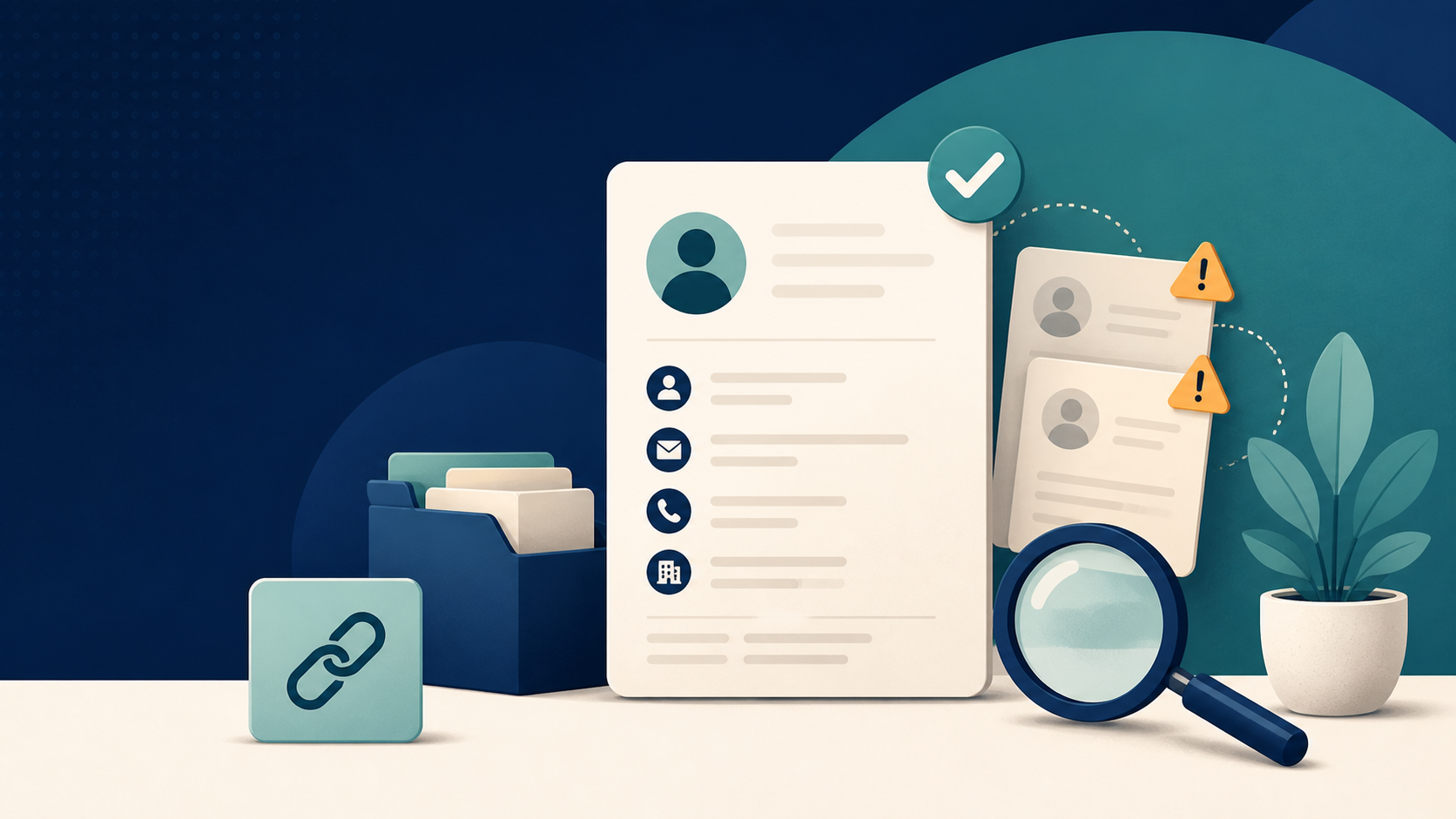
Give assistants a conflict protocol that preserves evidence, limits corrections, and keeps an uncertain record from spreading through connected systems.
Key takeaways
- Name the authoritative source for each field before conflicts appear.
- Pause the affected action while unrelated, safe work continues.
- Preserve the original evidence and use reversible corrections.
- Close the loop in every connected system after an owner decides.
A source can be official and still be wrong
A CRM, order system, applicant record, or spreadsheet may be designated as the source of truth, yet it can contain a stale address, a duplicate person, an impossible date, or a status that conflicts with direct evidence. Calling one system authoritative settles where approved values belong. It does not make every value accurate. An assistant needs a response that is safer than either extreme. Blindly copying the value spreads the defect. Quietly overwriting it may erase history, break a downstream process, or exceed the assistant's authority. The right move depends on the field, the evidence, the consequence, and who owns the decision. Write the protocol before the first conflict. For each important field, name the system of record, acceptable supporting evidence, who may correct it, which actions must pause, and where the decision is logged. A shipping address supplied in a verified customer channel follows a different rule from a salesperson's guess about company size. A typo in an internal label follows a different rule from a changed bank account.
Classify the conflict before touching the record
Begin by describing the discrepancy without deciding which side is true. Record the field, current value, competing value, source links, timestamps, related transaction, and the action that exposed the problem. Avoid copying more personal data than the reviewer needs. Then classify the conflict. A format problem may be reversible and low risk. A duplicate may affect ownership and reporting. An identity mismatch, payment change, consent status, safety issue, or legal record should move to a restricted review path. The category determines both urgency and who may see the evidence. Consider a customer email saying, "Use my new address," while an open order still shows the old one. The assistant should not assume the email alone authorizes a shipment change. They should check the company's approved verification and cutoff rules, preserve the request, and route the order if authority or timing is unclear. They may still complete unrelated work on the account if that work does not rely on the disputed address.
Use an evidence hierarchy, not personal confidence
Rank evidence for each workflow. A signed approved agreement may control a contractual name. A verified customer update may control a communication preference. A product information system may control an approved specification. The hierarchy should also state when newer evidence beats older evidence and when a second check is required. Do not tell assistants to use "common sense" for consequential changes. That phrase hides different assumptions. Give observable rules: which channel counts as verified, which fields need dual approval, what timestamp controls, what evidence is unacceptable, and what contradiction requires a stop. When two sources have equal standing, the owner decides. The protocol should allow the assistant to say what they do not know. A useful escalation reads: "The CRM lists Acme North as owner, but the signed handoff dated Friday assigns Acme Central. A renewal reminder is due today. I paused the reminder and linked both records for the sales operations owner." It separates evidence, impact, and action without inventing a resolution.
Make corrections reversible and visible
Where the system supports history, correct the field through its normal audited workflow rather than deleting the earlier value. Link the approval or evidence, record who acted, and note the effective time. If the system lacks history, use the approved change log instead of burying the explanation in a private message. For low-risk, obviously reversible defects, policy may allow direct correction followed by sampling. Examples might include removing extra whitespace or applying an approved country code format. Be careful with defects that look cosmetic but identify a person or transaction. Changing a candidate's name, merging customer profiles, or replacing a tax identifier can alter search, ownership, consent, and reporting. Never solve a conflict by building an unofficial shadow spreadsheet that becomes a second source of truth. A temporary exception queue may be necessary, but it needs an owner, access limit, resolution deadline, and closure rule. Once the approved system is corrected, close or link the exception so future staff do not act on stale notes.
Verify the correction across the whole path
A record change is not finished when one screen looks right. Check the destinations that rely on the field: scheduled messages, open orders, reports, integrations, exports, or downstream queues. Some systems synchronize slowly; others copied the former value when the transaction began. Define which items update automatically and which need a separate approved action. Test closure with a deliberately bounded example. Choose one corrected record and trace the disputed field from its intake evidence through approval, the authoritative system, an integration, and the next operational use. Ask a reviewer who was not involved in the correction to explain what changed and why. If they must rely on chat history, personal memory, or an unlabeled spreadsheet, the evidence path is incomplete even when the visible value is now correct. Set a deadline for unresolved conflicts based on consequence, and define an interim state that downstream users can recognize. “Pending verification—do not ship” is more useful than a private note known only to the original assistant. The owner should either approve a correction, reject it with the controlling evidence, or document why the record remains uncertain. Aging exceptions deserve review because an indefinite pause can become its own source of customer harm and inaccurate reporting. Sample conflicts monthly. Look for recurring sources, fields, integrations, and reviewers. If assistants repeatedly find the same wrong region code, repair the intake or mapping rather than praising a growing correction queue. Track unauthorized edits and missed conflicts, but also track appropriate pauses. A low escalation count can mean a clean process or hidden uncertainty. The US Federal Trade Commission's [Protecting Personal Information guide](https://www.ftc.gov/business-guidance/resources/protecting-personal-information-guide-business) advises businesses to keep only needed personal information and restrict access. NIST's [data integrity definition](https://csrc.nist.gov/glossary/term/data_integrity) describes data that has not been altered without authorization since creation, transmission, or storage. Use rules suited to your systems and obligations. For a controlled CRM correction lane with a named review owner, see our [sales support assistant services](/services/sales-support-assistant) or [contact us](/contact).
Provider questions to copy
"Can you show how this role is screened, trained, checked each week, and replaced if fit is poor?"
"Can we start with a small task list before we expand the role?"
FAQ
Should an assistant ever correct the source of truth directly?
Yes, when written policy authorizes that field and evidence type. Consequential or ambiguous changes should go to the named owner with the original evidence preserved.
Does the whole queue need to stop after one conflict?
Usually only the affected action and dependent records need to pause. Unrelated work can continue if it does not rely on the disputed value.
What belongs in a conflict escalation?
Include the disputed field, both values, source links and timestamps, affected action, deadline, and the safe step already taken.
Sources and notes
These sources are included as planning references. They do not replace legal, tax, security, or HR advice.
- FTC Protecting Personal Information: Official guidance on minimizing and restricting access to personal information.
- NIST Data Integrity Definition: Official definitions and source publications concerning unauthorized alteration of data.