

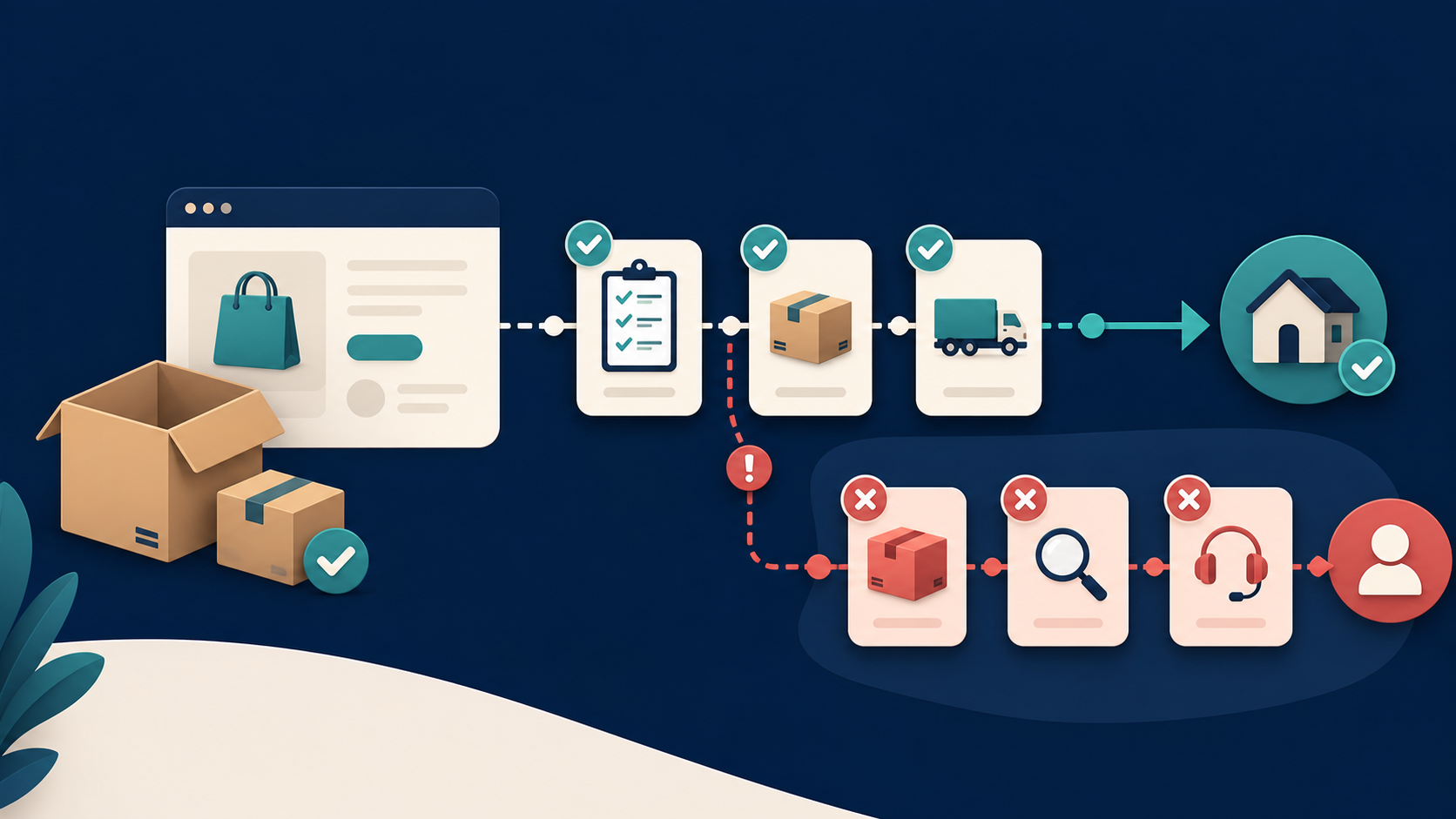
The operating problem
Ecommerce operations fail quietly when product facts drift across channels, inventory sources disagree, fulfillment exceptions age without an owner, or customers receive a confident answer that does not match the actual order. Volume magnifies small record errors.
An assistant can maintain routine work, but should not invent product claims, choose prices, decide suspected fraud, issue unusual refunds, or hold broad store and payment permissions. The safe lane keeps source evidence and exceptions visible.
Who this role is for
This lane serves online stores with documented catalog, order, fulfillment, and customer update routines that need consistent daily execution. This service fits when catalog maintenance and order exception coordination recurs often enough to document, the team can name approved product records, platform status, fulfillment evidence, and store policy, and a store owner is available to review exceptions. It is not a substitute for an undefined role or an absent decision maker. The strongest starting point is one bounded queue that can be observed, practiced with safe information, and measured against a finished example.
How the work should be organized
Name the authoritative product, inventory, order, and fulfillment sources. Define required listing fields, image rights, publication state, return language, and the owner for conflicts. Test with a catalog batch containing deliberate discrepancies.
For orders, document normal statuses, expected time windows, approved customer messages, and escalation triggers. The assistant updates from observed platform or partner evidence and never marks an order complete simply to clear a queue.
Separate catalog, support, analytics, payment, billing, and administrator permissions. Review early product changes and order notes, then sample high risk categories and repeat exceptions after the workflow stabilizes.
Inputs required before access
An assistant cannot produce reliable work from missing context. Assemble these inputs, remove obsolete versions, and identify the owner who can clarify each source.
- Approved product information, images, rights, claims, and channel rules
- Order, fulfillment, return, and customer response procedures
- Authoritative inventory source and discrepancy process
- Pricing, promotion, refund, and fraud approval owners
- Store access matrix plus publishing and rollback workflow
Work included
Catalog upkeep
Prepare or update product facts, variants, assets, links, and availability only from approved source records.
Order monitoring
Check order and fulfillment status, record evidence, and follow the routine partner or customer update path.
Customer updates
Send approved factual messages for covered shipping, return process, and product information questions.
Exception triage
Surface inventory conflicts, damaged shipments, stalled orders, fraud signals, and unsupported claims with complete context.
Merchandising support
Prepare collections, tags, and scheduled changes for review without deciding prices, claims, or campaign strategy.
Concrete deliverables
Deliverables should be reviewable without a manager reconstructing the assistant’s activity. Each item needs a current state, source, owner, and visible exception where applicable.
- Source checked catalog changes with approval status
- Order and fulfillment queue with current evidence and owner
- Approved routine customer updates linked to the order record
- Inventory discrepancy, stalled order, and damaged shipment report
- Publishing checklist with links, assets, claims, and rollback note
Quality controls
Quality review should inspect evidence and decisions, not screen presence or raw activity counts. Use a consistent sample, discuss corrections, and update the operating guide when a missing rule causes repeat errors.
- Require a source and review state for every customer facing product change
- Keep pricing, discounts, refunds, claims, and fraud decisions with authorized owners
- Separate catalog and support permissions from payments, billing, and store administration
- Sample live listings and order notes for accuracy, links, variants, and correct escalation
Human decision boundaries
- The assistant does not create performance, health, comparison, sustainability, or legal claims without approved evidence.
- Price changes, discounts, unusual refunds, fraud outcomes, and customer remedies stay with the store owner.
- Payment details, payout settings, store ownership, billing, and account recovery remain restricted.
A realistic example
Inventory quantities conflict across systems
Context: The store platform shows an item available while the warehouse feed shows zero units and an open order depends on the difference. Publishing either value without review could create an oversell or hide available stock.
Assistant response: The assistant captures both sources and timestamps, pauses the affected customer facing update, flags the open order, and routes the conflict to the inventory owner. A customer message is prepared only after the owner confirms the status.
Manager review: Review checks whether the assistant used the authoritative path, protected the customer from unsupported information, preserved the order context, and documented the final correction across channels.
Launch this role
Launch is a controlled transfer of one queue, not a single account handoff. Keep early scope small enough that a reviewer can see every material result and correct the system before volume grows.
Map the first queue
Choose one recurring ecommerce assistant workflow. Record its trigger, approved product records, platform status, fulfillment evidence, and store policy, expected finish, normal due time, and the store owner who resolves an exception. Remove obsolete instructions before a candidate sees them.
Run safe representative work
Build a paid sample that resembles source backed listings, current order notes, routine updates, and an exception queue but uses invented, redacted, or otherwise approved information. Include a normal item, a missing input, and a refund, fraud signal, inventory conflict, or unsupported product claim. Score accuracy, completeness, communication, and whether the candidate stops at the right boundary.
Open minimum access
Create a named account and grant only the systems and records needed for the opening queue. Keep administrator rights, account recovery, exports, and pricing, refund, fraud, product claim, and store administration decisions with authorized owners. Record the access owner and removal path before live work begins.
Review before expanding
Inspect every early output or use a risk appropriate sample. Compare the work with source evidence, discuss exceptions, and correct the written process. Add volume, tools, or task ownership only when the evidence is stable and the store owner agrees.
Frequently asked questions
Can the assistant change prices?
Only when an approved source and explicit publishing workflow authorize the exact change. Pricing strategy, exceptions, and unplanned discounts stay with the owner.
Can the assistant decide a fraud case?
No. The assistant may gather order context and flag defined signals. The authorized owner, payment provider, or approved process makes the outcome decision.
Can this role answer customer questions?
Yes, for categories with current approved guidance and adequate account context. Refund, safety, claim, and policy exceptions follow the support escalation route.
How should store access be limited?
Use named roles for catalog or support tasks. Keep payments, billing, ownership transfer, account recovery, broad exports, and app administration restricted.
What is a good opening sample?
Use a small catalog with variant conflicts, missing evidence, a rights issue, and an order exception. Evaluate accuracy, source use, and safe stopping behavior.